
Touring with disabilities

Touring with disabilities

Getting started with your vehicle

An appreciable number of our members tell us they have some form of disability – around 25%. We try very hard to make our campsites and our services as accessible as possible. Our disabled members typically spend the same number of nights on our campsites per year as anyone else, and the experience ratings for our campsites are almost identical whether people identify as disabled or not. So what makes our kind of holidaying work so well?

Your home from home

People’s needs can vary greatly. Accommodation providers like hotels may try hard to justify an ‘accessible’ description for a room, but ultimately, if their decisions on what that means differ to yours, it won’t be ideal. You may not know that until you arrive for your stay, though. However hard they try, it will at best be an unfamiliar space, which can itself be an issue for people with a wide variety of conditions, from partial sight to neurodiversity. And while self-catering accommodation is always an option, hotel restaurants can be an uncomfortable experience for some.

Your own home is the opposite – a safe, familiar and comforting space which you’re likely to have tuned to suit specific needs, where you live by your own rules (or lack of them!) So why not take that familiar, appropriate space with you on holiday? In effect, that’s what a touring holiday in a leisure vehicle can offer. You may find that there’s an off-the-shelf option of leisure vehicle that already meets your needs. If not, there are plenty of ways to adapt standard designs to suit you. It’s hard to list even a fraction of the possible options, but here’s a few ideas to show the possibilities.

Coachbuilt GB adapted caravan

Photo by Alan Bond

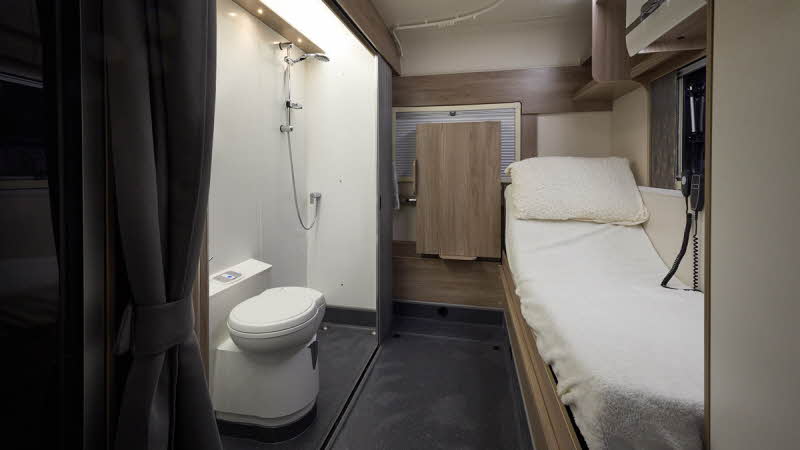
Electric adjustable bed and wet room in a Swift Escape 674 adapted by Coachbuilt GB

Standard caravans

These can be very affordable and don’t necessarily need a huge car to tow them (our Technical Advice helpline can help with what your car can tow, or what you might need for a larger model). Once inside, everything tends to be readily to hand and many models have fixed beds so there’s no need to build a three-dimensional jigsaw every night. If you can stand, but steps up and down are an issue, there are portable electric lifts available which will work with any caravan. Wheelchair access needs a bit more modification, but doors can be widened and ramps added.

Things to consider: If your car is wheelchair accessible, with access from the rear, it’s very unlikely you’ll be able to fit it with a towbar.
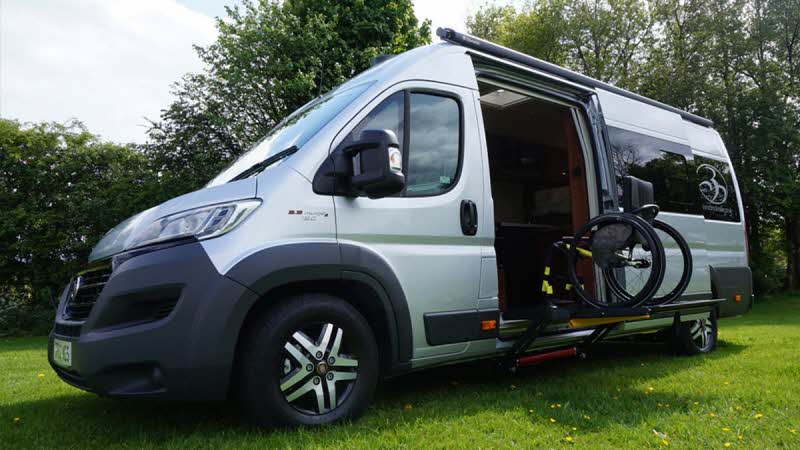
Brook Miller Mobility wheelchair accessible motorhome

Campervans and Motorhomes

They tend to be more expensive, but their scope for adaptation is even greater, as their generally higher payload capacity means it’s easier to do significant modifications, especially for those with physical conditions. It’s possible to not only have wheelchair ramps or lifts, but also ceiling track hoists and wet rooms. The vans these vehicles are based on can have their driving controls adapted, or seats can be removed to accommodate wheelchair users. All that comes at a price, of course, but these vehicles are eligible for VAT relief in the same manner as other motor vehicles used by disabled people.

Things to consider: Larger motorhomes in particular are suited to taking extra kit with you. Some have a rear 'garage' which will hold a mobility scooter or wheelchair.

Camp-Let Passion folding camper

Photo by Alan Bond

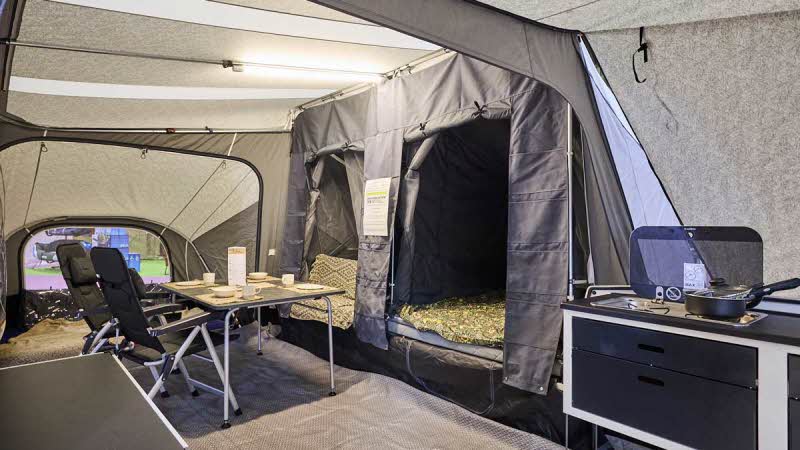
This folding camper from Camp-Let has ground-level step-free access to the main living area and beds raised off the floor

Other options

Sometimes the simplest options are the best. A larger tent can be a surprisingly accessible space, with ground level step-free access. Sleeping on the ground may be an issue, but a trailer tent (or their more common, slightly more sophisticated cousin, a folding camper) can solve that. Many models retain a tent’s step-free access to the main living area, but have beds at a convenient height off the ground in the trailer section. They’re surprisingly affordable too, especially secondhand.

Small tents can be a private, personal space which appeals to many. Used in conjunction with a caravan or motorhome they can be a daytime sanctuary as well as a restful place to sleep. And their compact size and portability means they can be used in the garden at home (or even indoors) to develop familiarity.

Things to consider: Almost all leisure vehicles other than the very smallest models have their own toilets. Other than in highly adapted models, that won’t be an accessible facility, but it has the huge advantage of being there whenever and wherever you’re travelling.

The Coachbuilt GB LIV Swift Escape 674 has a great cab with white body.  There are grey and turquoise decals.  There is a large canopy awning with a stand and plant to the right of the habitation door.

Where will your adventure take you?

Blind man with Guide dog

UK Club campsites

Find out more about how we cater for accessibility needs and non-visible disabilities on our campsites.

Find out more

Côte d'Azur, France

Touring in Europe

Discover your perfect overseas holiday with our handy guide.

Tour overseas

Troutbeck Head Experience Freedom Glamping

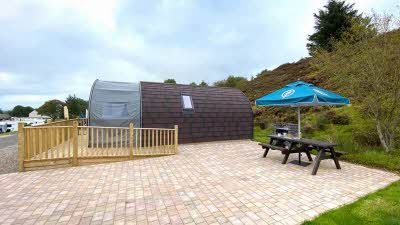
accessible glamping pod at Troutbeck Head

Glamping

Accessible glamping opens up the great outdoors to everyone, combining the beauty of nature with thoughtful, inclusive design.

Accessible glamping breaks