Low emission zones
There are a number of countries that have introduced low emission zones in towns and cities across Europe so keep in mind the driving rules and regulations when you're touring.
Read more
Some of the rules related to the Zero Emission Vehicle Mandate have changed. Club Technical Manager Martin Spencer looks at what this means for caravanners and motorhomers
Behind the scenes, we work hard to understand what’s happening with vehicle technical and legislative developments and exert influence where we can on your behalf. Following updates in the news recently regarding emissions and the future of new car sales, here I’ll take a look at the state of play regarding towcars and motorhomes...
 The Towcar of the Year 2025, Volvo’s XC60 T6 Plug-in Hybrid AWD Plus, will readily tow an 1,800kg caravan
According to the Club’s 2023 Leisure Vehicle Survey, 86% of members towed with diesels, 8% with petrol cars and 5.5% with hybrids at that time. Few (so far) have chosen electric towcars. That’s unsurprising as diesels suit us very well. But when asked what your next towcar would be, 65% of respondents said that they would opt for diesel, 7% petrol, 25% hybrid and 4% electric.
That’s a significant development, but not really reflective of the overall UK car market. For the first quarter of 2025, new cars were just 6% diesel, 49% petrol, 24% hybrid and 21% electric, with diesel sales still falling. (Source: Society of Motor Manufacturers and Traders (SMMT).) As things stand, future towcar buyers will be steered away from diesel, as availability of new and younger second-hand diesel models diminishes.
A major influence is government policy, particularly the ZEV (Zero Emission Vehicle) Mandate requiring manufacturers to sell increasing proportions of new zero emission cars from 2024 to 2035 or face fines. The target for 2025 is that 28% of new car sales are zero emission. With no viable current alternatives, that’s 28% electric. For 2030 the target is 80%, with exemptions for low-volume models like specialist sportscars. For 2035, it’s 100%.
We’ve just had consultation with the Government to clarify what you can buy new from 2030-35. I had hours of meetings with Department for Transport officials and also used our motor industry contacts via their trade body, SMMT, to build consensus with other niche sectors like wheelchair accessible vehicle makers, who also face challenges in adapting to electric vehicles (EVs).
In response to submissions from ourselves and others, the Government responded with:
So, we have 10 years before new towcars must become fully electric. Hybrids should be a viable alternative until then without excessive cost or range concerns, as EV makers hopefully continue to address current limitations affecting towing (towing limits, purchase price and/or range, especially with heavier caravans). And if you want to continue with an existing diesel or petrol car, you can, although I suggest we’ll see reduced availability of new and hence younger second-hand ones well before 2030.
We’ve assessed new car technologies for many years, particularly through our Towcar of the Year competition. The current outright winner is a hybrid, as was the previous one. EVs have won some weight category classes, but not (yet) the overall title. I think that shows our scoring criteria and judges are well aligned with members’ priorities and needs.
We first tested an EV back in 2019 (Jaguar I-PACE). It managed just over 100 miles with a sensible reserve in the battery, towing 750kg. Six years on, there are cheaper EVs which tow twice that weight almost twice the distance. The most capable will tow 3,500kg (at a price). The pace of change is impressive and both EVs and hybrids have appealing towing characteristics, including great low speed manoeuvrability and hill starting.
Movement towards electrified (hybrid) and electric cars is inevitable, I think, but becoming less concerning as technology advances. It’s worth remembering diesel didn’t become popular for caravanners until the late 1980s… 40 years on, it’s just about time for another change.
It’s no surprise that 97% of members’ motorhomes are diesel. There’s little sign yet of any appreciable switch to alternatives. We’ve seen a handful of electric motorhomes on Club campsites (mainly one-off campervan conversions) and Volkswagen has just started offering a hybrid California.
The wider van market shows evidence of some switching – 5.5% of new sales were EVs in the first quarter of 2025, but 92% remained diesel. However, those EVs are mainly used for urban delivery purposes with limited daily mileage, modest speed and significant regenerative braking. EVs don’t really work as motorhomes yet – they would need a huge (heavy, expensive) battery and manufacturers would struggle to offer an adequate payload for those with a 3,500kg limit on their driving licences. We need significant further development before an EV future for mass-market motorhomes is possible.
Vans have similar ZEV Mandate rules to cars – 80% ZEV by 2030 and 100% by 2035. However, motorhomes, being ‘special purpose vehicles’, were exempt from those rules until 2030, following previous consultation we had with the Government. I’m delighted (and relieved) that the recent consultation extended that to 2035. That’s an important ‘win’, as both van manufacturers and motorhome converters need longer to adapt. Arguably, even 2035 might be too soon – we’ll keep this closely under review.
We must prepare for change, though. In response to 2022 government consultation, there’s now legislation going through Parliament to raise the weight limit for ZEVs which can be driven on a Category B car licence from 3,500kg to 4,250kg, making it easier to allow for battery weight. The draft law reflects all our ‘asks’: all vehicles in scope (not just goods vehicles), no additional training and permitting trailer towing. That change causes other challenges – currently, 4,250kg commercial vans have different rules for MOTs etc. Those don’t directly affect motorhomes, but discourage heavier van sales and thus potential base vehicle availability. Therefore, we supported consultation this year to extend rules for 3,500kg vans to 4,250kg.
What about EV alternatives, notably hydrogen and synthetic fuel? At present, while there’s development in both, neither is a government priority for smaller vehicles, so they are unlikely to become generally viable before the ZEV Mandate first forces an electric solution. We’ll keep monitoring this.
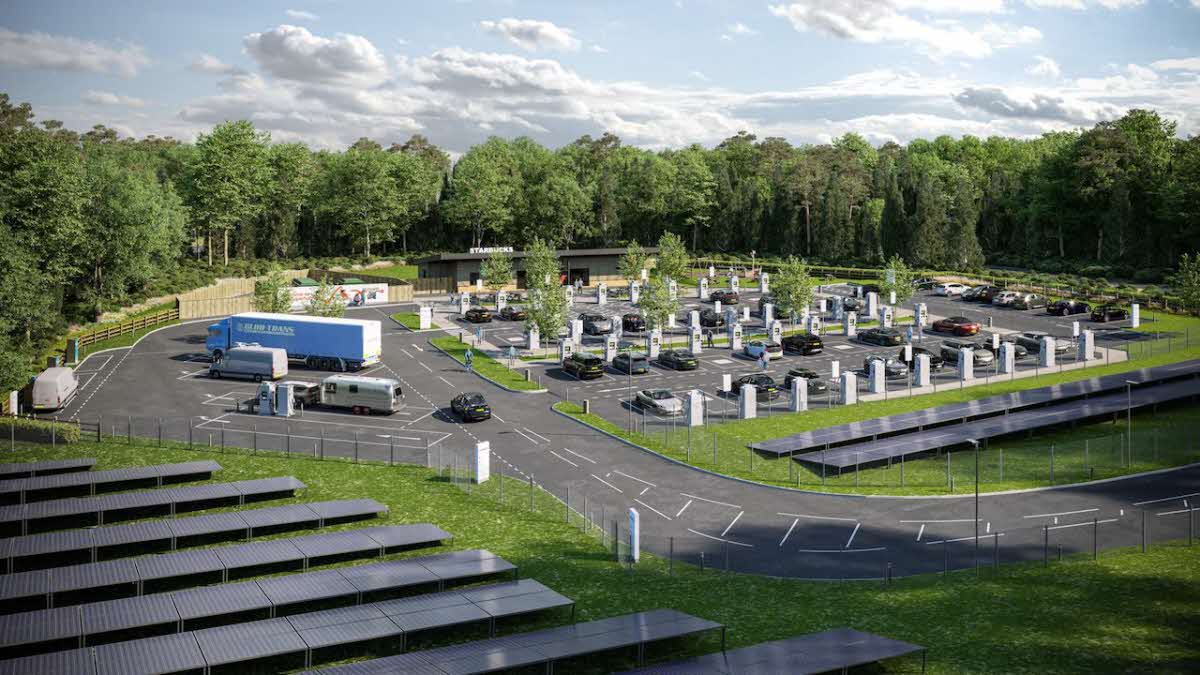 Artistic impression – Instavolt’s Winchester hub has space for all kinds of vehicles
If EVs are the future, then charging infrastructure is key. I’m part way through a series of speaking opportunities this year in industry meetings and public conferences where I’m making the case for larger charging bays (for motorhomes and other longer vehicles) and pull-through bays (for caravans and large motorhomes). We’re starting to see progress in this area, like the InstaVolt hub off the A34.
Terms explained
Meet the Manager

As Club Technical Manager, I provide some of the advice offered by the Club, but also do much representative work with organisations as diverse as British Standards, trade associations, manufacturers and the Government. That gives us knowledge and influence, ensuring the Club can effectively advocate on members’ behalf at a time of great change in vehicle choices.