Top sites for nature
Land yourself among Britain's best nature spots.
Discover Britain's wildlife
The huge white-tailed eagle has bounced back from extinction in the UK – David Chapman observes this impressive creature at close quarters
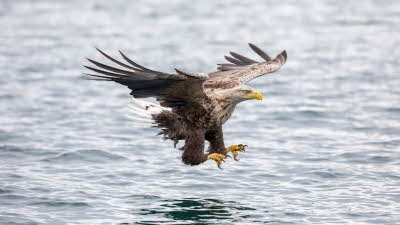
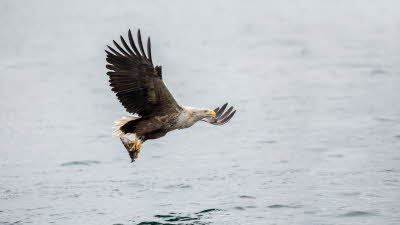
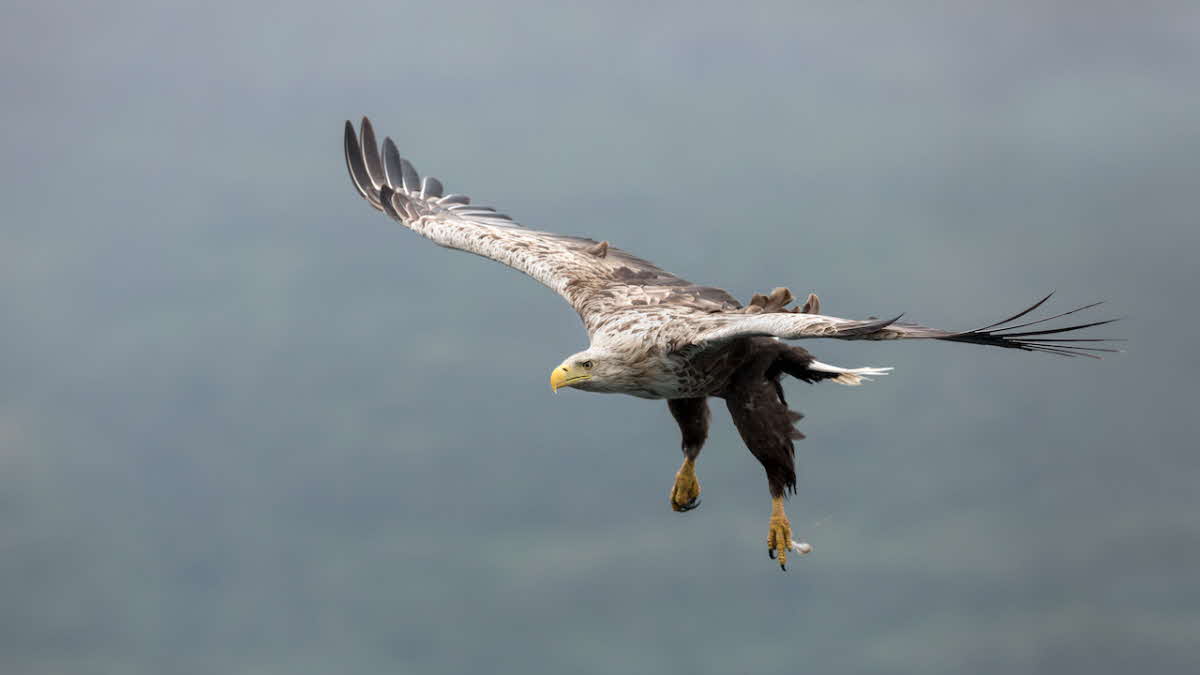 A white-tailed eagle begins its dive
I haven’t always been a fan of the white-tailed eagle. Yes, it’s massive – with a wingspan of up to 2.5m it is our biggest bird of prey – but that aspect of its appearance didn’t particularly appeal to me. Most of my early recollections of white-tailed eagles are of distant birds squabbling over a dead fish on the shoreline, or a distinctive, looming ‘barn door’ shape as a huge pair of wings inelegantly drifted high over the distant mountains.
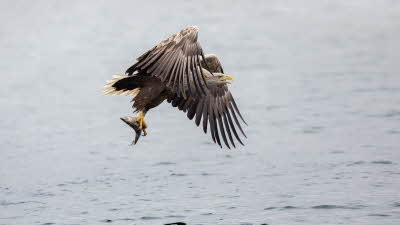
But things change. In my recent experiences with these birds, I have been impressed by their huge hooked bills, and when they take fish from the surface of the sea that ‘barn door’ is more a streamlined arrow, with eye and talons coordinating to perfection. It’s an impressive bird, and I can understand why so many people have worked so hard to bring this mercurial creature back from extinction in the UK.
White-tailed eagles can be found across much of Europe, particularly in the north and east. They used to be widespread in the UK, but we hunted them exhaustively, first in England during the 18th century and subsequently in Scotland during the early 20th century. Interestingly, in England, the last known breeding sites included the Isle of Wight and the Isle of Man.
The first – unsuccessful – attempts to reintroduce the eagles took place in the northern isles in the 1950s and ’60s, when birds were brought over from Norway. A further attempt was made on the Isle of Rùm in the 1970s and ’80s, and in 1985 the first successful breeding occurred. Additional birds were released to bolster the slowly growing population of the Inner Hebrides and by the turn of this century there were 22 pairs, with a large concentration on Mull.
More introductions have taken place in eastern Scotland and, more recently, on the Isle of Wight. They travel widely, so there are now sightings of these impressive birds along the south coast of England – but north-west Scotland still offers the best chance of spotting them: 150 pairs were reportedly breeding successfully in 2020.
The slow increase in population is partly due to the fact that eagles don’t usually breed until they reach the age of five – and only about a third of young birds survive to that age.
They often make their nests in tall trees, but they also use cliff ledges, and once they have found a territory they tend to stay there for life. Each season the birds will attempt just one brood, which might contain two or three eggs. Although their productivity is fairly low, their life span is quite long, with birds sometimes reaching 20 years old.
White-tailed eagles are scavengers that readily take carrion, but they are also skilled enough to kill prey, including rabbits, seabirds, waterbirds and fish. Both males and females will collect food for their young, but it is the female that does the lion’s share of the work and most of the direct feeding of the chicks on the nest.
The young fledge after about 70 days, but remain reliant on their parents for the next five or six weeks. After that they begin to roam, often quite widely, to find a suitable territory of their own.
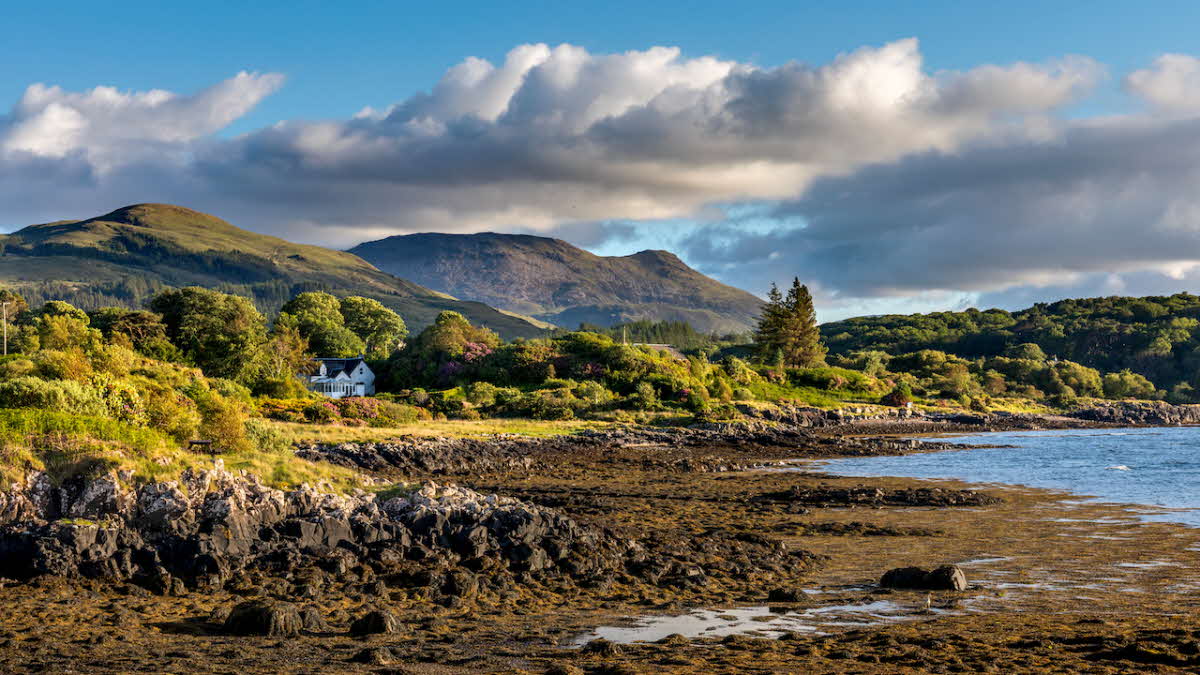 The Isle of Mull is a great place to see white-tailed eagles
Identifying a white-tailed eagle is relatively straightforward. The only other bird of a similar size is the golden eagle. The white-tailed species has very broad, very rectangular wings with splayed ‘finger’ tips. So big are the wings that its tail and head appear very small, hence the ‘barn door’ analogy. As its name suggests, the adult eagle’s tail is white, though on juveniles it is brown. Its head is paler than its brown body and wings, and its beak – should your encounter be close enough – is yellow.
Their liking for fish gives those on tourist boat trips the chance to spot them. Last year, my wife, Sarah, and I joined a tour from the Isle of Mull and we were both mesmerised as, time after time, eagles swooped down beside the boat to snatch the floating bait. We were close enough to see the colour of the birds’ eyes and hear the splash as the fish were swept into the air. It’s impossible not to be impressed by the skill and dexterity of such a huge bird at this proximity. My opinion of the white-tailed eagle has changed for good!
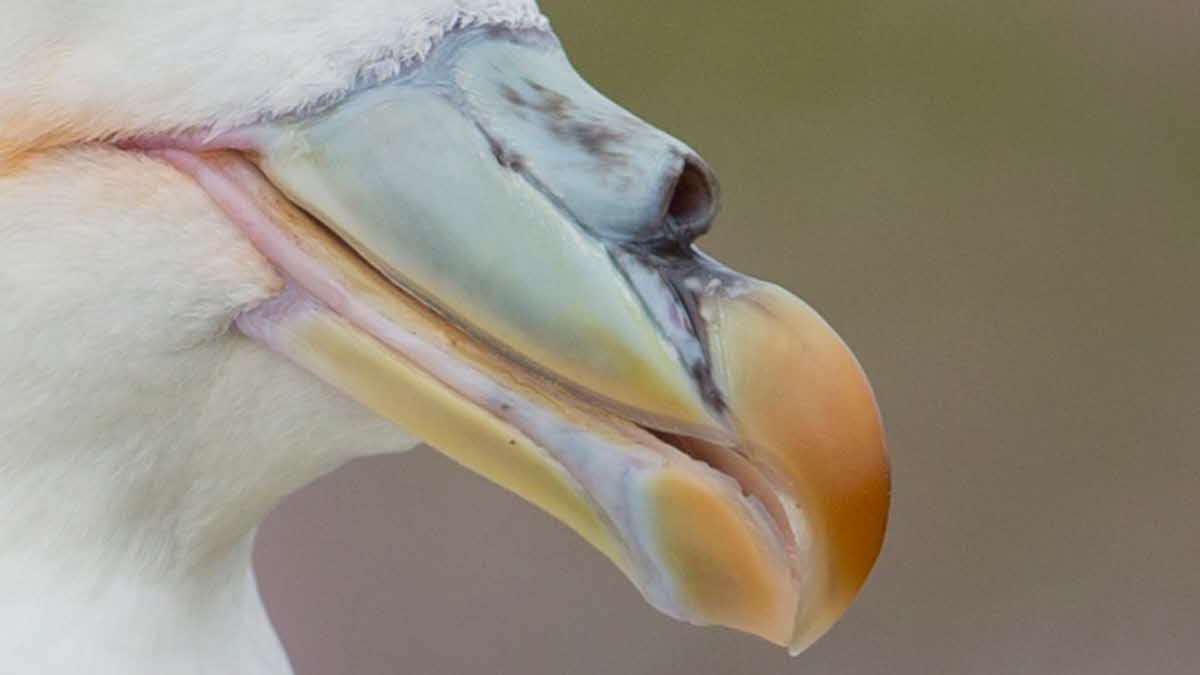
I will show you a photo of something from the natural world in every issue of the Club magazine. It might be a close-up, or a subject which is difficult to identify. All you have to do is figure out what it is! Here is this issue’s photo; no clues or prizes – it’s just for fun.
I will give you the answer next month, but if you can’t wait, log in to the Digital Magazine. The subject of the mystery photo in the June/July issue was: a beaver.