Top nature campsites
You’ll be amazed at the variety of animals to spot on some of our Club campsites
View our top nature campsites
David Chapman observes a variety of creatures and plants during a frosty walk
It had been a cold night, but I was still determined to make an early start. I stepped outside and, once the mist had cleared from my specs, I could see there had been a frost. I took a deep breath and the cool air hit the back of my throat – it tasted clean and fresh. I happily filled my lungs before donning a woolly hat, scarf and gloves. It was time for my regular walk in the Cornish countryside.
This walk takes me through woodland, across farmland and even diverts into a small patch of heathland before finally heading out onto a bracken-covered hilltop. I enjoy a familiar walk; knowing every inch of the way like the back of my hand means I spot all the seasonal changes, and with nature as my companion no two days are ever the same.
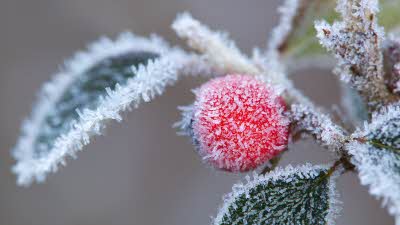
The sun was about to rise above the hills to the south-east, but as I descended into the valley bottom the temperature dropped and I entered an ethereal world where everything was decorated with frost crystals. Beside the river the stony ground is home to heather and gorse. By the time winter comes, the heather has finished flowering, but its brown seed heads are still attractive. By contrast, the gorse is just starting to put on a show and the yellow of its petals leaps out from winter’s muted colour palette.
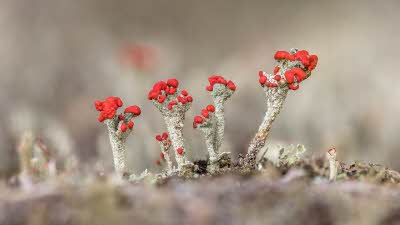
As the frost yielded, its melting crystals revealed small patches of colour on the ground. A huge variety of lichens grows around the base of heather, creating a world in miniature. My favourite is the matchstick lichen, a distinctive red-capped species. Though tiny in size, it adds a welcome vibrancy on a cold day.
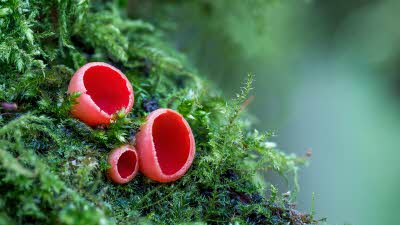
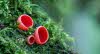
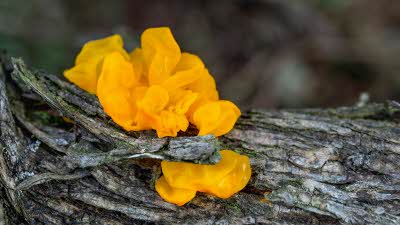
Among the moss-covered twigs and branches at the damp edge of the wood I found a bigger burst of red: scarlet elf cups. These fungi, each about the size of a penny, are quite sufficiently described by their name. There’s another even more peculiar and equally colourful fungus: the yellow brain fungus. This grows on the gnarled, old stems of gorse bushes, and has a jelly-like structure with folds and lobes that loosely resemble the shape of a brain.
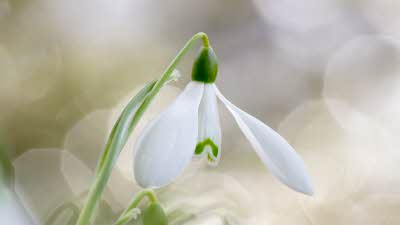

A short stretch along a country lane takes me past a couple of patches of snowdrops. Their delicate nodding flowers seem to rise earlier each year. The frost which had caused the leaves of some plants to wilt hadn’t affected them; they can store water outside their cells so the frost crystals don’t shatter their structure.
Nearby, on a south-facing bank, I briefly picked up the sumptuous scent of violets in flower. Their fragrance is created by a chemical called ionone, which initially stimulates our olfactory system but then quickly blocks our receptors, making our sensory encounters with sweet violets regrettably ephemeral.
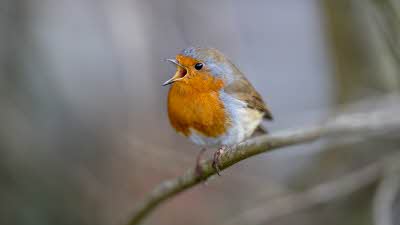
I could now feel the warmth of the sun on my back. As I removed my hat and gloves the birds also began to respond to the rising temperature. A robin poured out its distinctive tune, and from a distant treetop a song thrush put heart and soul into a series of repeated phrases. A flicker of something on a post beside the hedge caught my eye. It was a dunnock, often inappropriately called a hedge sparrow. Many consider them drab but I strongly disagree. They might not be particularly colourful, but they have loads of character. Sensing spring in the air, this individual was displaying to another by perking up its tail and flicking its wings faster than my eye could register. Certainly not drab.
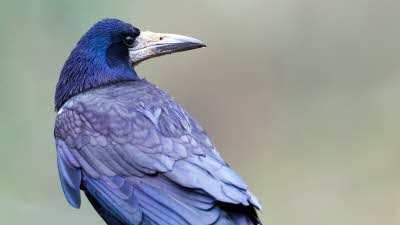
The nearby trees hold a rookery and its inhabitants too were sensing a change of season. While some flew down to the ground to collect twigs to bolster their nests, others remained in the canopy only to steal their neighbours’ finds.
I wondered whether there is any truth in the notion that conditions over the coming spring can be predicted by how high rooks build their nests: the closer to the top, supposedly the better the weather will be. As I could only see rooks refurbishing existing nests I remain to be convinced!
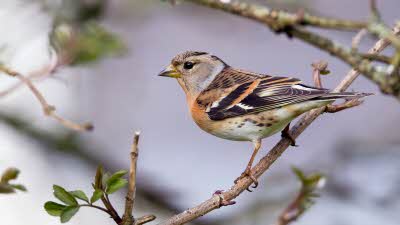
I am lucky that much of the farmland walk across is owned by the National Trust and some of the field margins are left unploughed over winter. This is where I see finches. Chaffinches, goldfinches and linnets take to the air in chattering flocks. I always pay attention when chaffinches head to the skies because there is a chance of spotting a few bramblings among them. Brambling are similar to chaffinches, but only visit the UK in winter. When they fly they can be distinguished by the white patch on their rump.
Farmland gives way to higher ground – a hill dominated by bracken, gorse and scattered bushes. It’s quiet up there in winter, but a pair of buzzards took off from a nearby wall and soared gradually higher into the sky. Their broad wings allow them to catch the thermals and they gain height effortlessly. In a bid to impress the other, one bird folded its wings and plummeted towards the earth. Not wanting to be outdone, the second bird performed a roll as if it was taking part in an air show. The two are partners and this is their way of bonding.
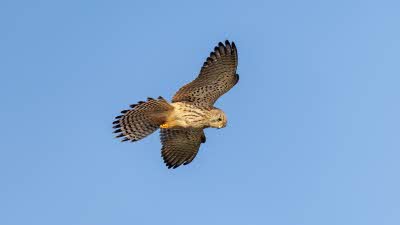
I also spotted a kestrel, hovering as only kestrels can. I had time to get my binoculars onto it and admire the way it uses wings and tail to keep its head still. Through the year kestrels will eat a variety of prey including beetles, slow worms and lizards, but in winter they focus their attention on small mammals, earthworms and sometimes even small birds. I am full of admiration for a bird that can spot and catch a field vole. The truth is the kestrel has an advantage; it can see in the ultra-violet spectrum which enables it to see where the voles have been marking their territories, and this gives them a big clue as to where to start looking.
It's mostly downhill from here to my house, and as I yomped home I chewed over the wonders of wildlife and smiled to myself at the beautiful things I had seen. I even enjoyed another fragrant blast of violets as I returned along the same lane.