

Great Savings Guide
Members can save up to 50% at attractions across the UK by using our Great Savings Guide.
See more
Jonathan Manning learns how to fashion a lampshade on a craft course – with impressive results
Light occupies a special place in the lives of humans – think ‘light at the end of the tunnel’ or ‘seeing the light’. It represents safety, security and warmth. Stroll through a campsite as evening turns to night, and the glow from inside caravans and motorhomes makes them look the cosiest of havens. The Danes call this hygge, a concept that encapsulates the alchemy of spending time away from the daily rush in a snug, low-key environment.
So, in a bid to turn up the hygge dial of my camping experiences, I’ve decided to learn how to make a lampshade. This will not only help cast a comforting light at the end of the day, but also add a dash of style to the notoriously functional interior of a campervan.
All of which leads me to Finch & Toad in Spalding, Lincolnshire, set in a small enclave of stables converted into studios, barely half an hour’s drive from Peterborough’s Ferry Meadows Club Campsite. The other studios are running courses on making mosaics, weaving tapestries, painting with watercolours and modelling with clay. Finch & Toad specialises in lampshades and upholstery, and today I’m the only attendee planning to make a lampshade – the four others are at various stages of salvaging and reupholstering old armchairs.
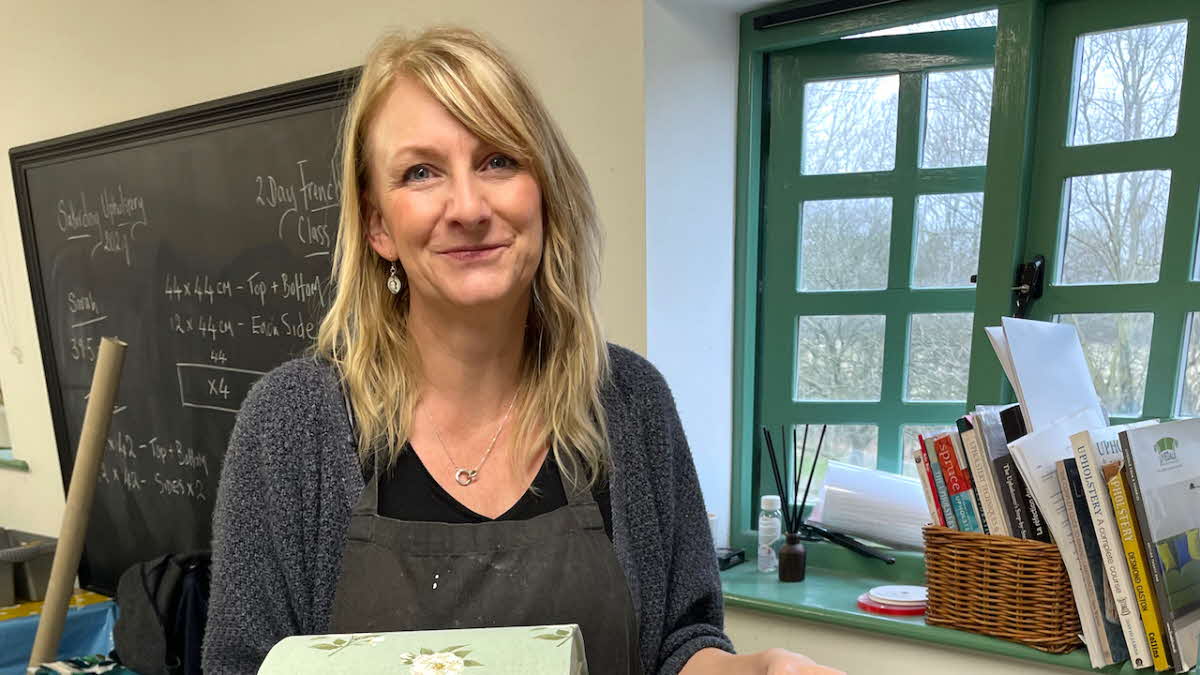 Jonathan's mentor Lee Hagon
This creates a relaxed environment, with everyone free to progress at their own pace, while Lee Hagon, who set up the business a decade ago, moves calmly from one workbench to the next, offering advice and demonstrating the skills and techniques required for the next stages of our projects.
Liberated from the need to keep pace with everyone in the group, I can plan, faff and practise until I feel confident undertaking a task for real. The good news is that it’s the choice of fabric that determines the attractiveness of a lampshade. The bad news is that every snip of the scissors is terminal – there’s no chance to correct a cutting error. More on than later!
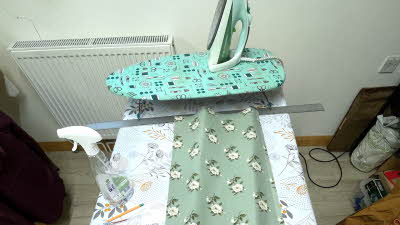

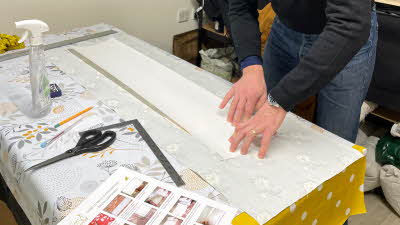
Cotton, linen, silk and velvet are all options, although for an absolute beginner Lee advises cotton, and asks me to arrive with a 50cm piece of fabric. Even as an off-cut, the material was more expensive than I expected – £16 for a metre (full price £32) – but Lee likes my choice.
“It’s got a good repeating pattern,” she says of the white roses. The implications of a repeating pattern didn’t cross my mind when I chose it, but Lee mentions the perils of animal prints that might leave dogs with no heads or rabbits without feet, depending on where you have to cut the fabric. Even with flowers there are complicated decisions to be made – do I choose to include two whole flowers and a narrow strip of a leaf from a third, or one whole rose bordered by two halves?
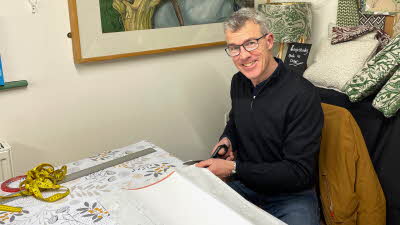
I spend several minutes manoeuvring the fabric up and down over the self-adhesive panel that will form the inside of the lampshade. The panel acts a little like a picture frame, determining which elements of the pattern will be visible. Once I’m happy, I pin the fabric to the panel, and with Lee’s guidance and Vernon Kay’s ‘Ten to the Top’ in the background, I peel back adhesive film and stick down the fabric, advancing just three to four centimetres at a time. “Now mark a perimeter of 1.5cm in pencil, add two ears at one end, and cut the fabric,” says Lee. The ‘ears’ are two small flaps that will neatly fold into the shade’s hem to stop the fabric fraying at the seam. I meticulously measure and draw them, before accidentally cutting one straight off.
Lee takes my clumsy blunder in her stride, reassuring me that it’s a common mistake and that there will be a solution.
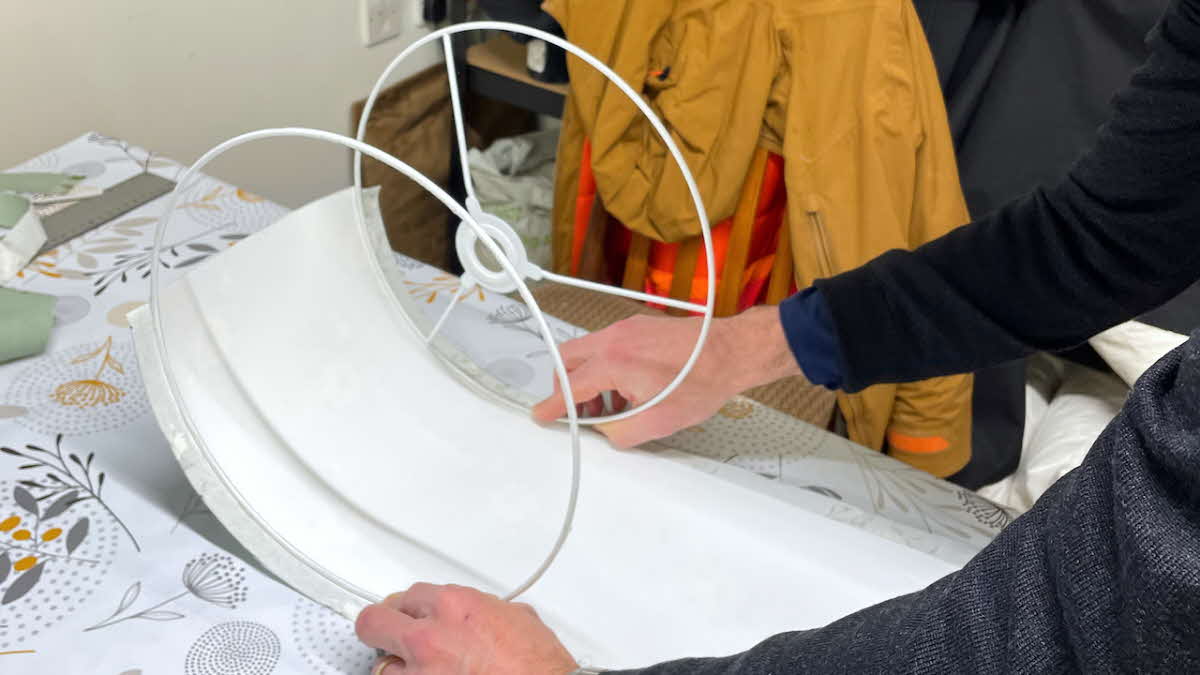
Fortunately, it’s straightforward to apply double-sided tape to the edges of the fabric and to the two rings that will form the top and bottom of the shade. I had wondered how the fabric would be pulled taut, but it turns out that there’s no technique beyond ironing it at the start of the day. The shade takes shape simply by rolling both rings at the same time along the upper and lower edges of the material, leaving a hem of just over a centimetre. The tape holds firm, and in barely 90 seconds the drum of the lampshade is complete.
 Jonathan made a lampshade at Finch & Toad in Lincolnshire
From here, it’s a matter of fine tuning. I press the fabric outside the rings against the tape, and then use the corner of a finishing tool, which looks like a blank credit card, to gently tuck the edges under the rings. With the tiniest dab of glue, applied with a cocktail stick, to seal the joins around the lower ring’s spokes, the shade is complete.
Now, normally when I return from a craft course, whether it’s woodwork, pottery or stone carving, my wife warmly congratulates me on what I have made before delicately suggesting I might like to keep it in my study, the shed or the garage. It’s the adult equivalent of a primary school child presenting their parent with an art class sculpture made of empty milk cartons and cardboard toilet rolls.
This time, however, once she has made me promise I didn’t buy it in an interior design shop, she whisks the lampshade from my hand and carries it straight into the lounge, where it immediately replaces a plainer one. Its life on the road in a campervan (for which it would probably have been too big anyway) will never begin, which is the greatest compliment I can pay to this course.
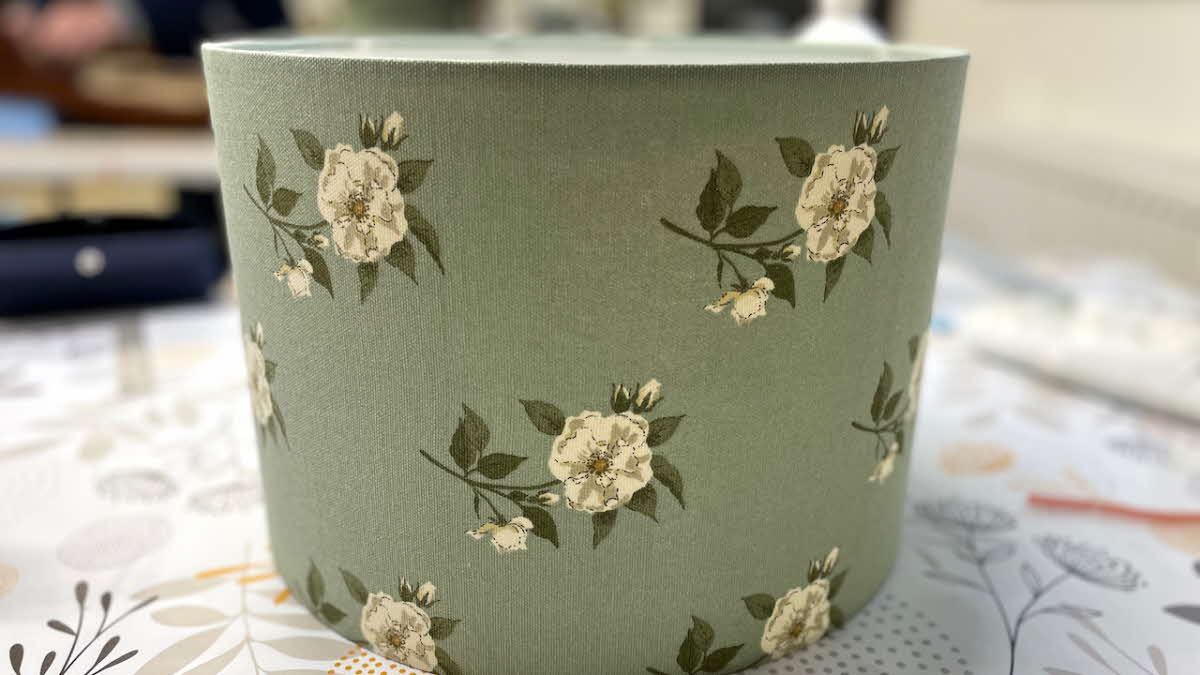
A half-day lampshade-making workshop with Finch & Toad costs £35.
Contact: finchandtoad.co.uk, 07979 528045
Stay: Ferry Meadows Club Campsite
• Grace & Favour Home, Devon
Make your own drum lampshade during a three-hour workshop (£38) in Bovey Tracey. Bring your own fabric or purchase on site.
Contact: graceandfavourhome.com, 01626 437676
Stay: Stover Club Campsite
• Lume Lighting, Sussex
Up your skills and create a traditional ‘bowed empire’ soft lampshade on this one-day course (£130), learning how to sew your (own) fabric onto your frame.
Contact: lumelighting.co.uk, 01273 723116
Stay: Brighton Club Campsite
• JSInteriors UK, Yorkshire
Up the ante on a two-day course (£225) offering expert tuition in making pleated, tailored or gathered lampshades.
Contact: jsinteriors.uk, 01723 850343
Stay: Scarborough West Ayton or Cayton Village Club Campsite