

Save on days out
Members receive great savings at attractions throughout the UK and Ireland with our Great Savings Guide
Start saving
Jonathan Manning joins a mudlarking tour and discovers a host of fascinating artefacts on the banks of the Thames

Twice a day the River Thames rises and falls by seven metres in central London, exposing centuries of history at every low tide. The powerful current acts like a heavy-handed archaeologist, its swirling waters sifting mud, sand and grit to uncover artefacts from the capital’s past, then repeating the process 12 hours later.
The river’s power means its banks are not going to lay bare perfect goblets, plates or vases. But the foreshore is littered with fragments and fossils stretching from 10,000BC to last Monday.
Bones, bottles and buttons punctuate pieces of pottery and ancient tobacco pipes. Swords and skulls wash up here – over 250 ancient human skeletal remains have been discovered, including the remnants of a Neolithic man that are over 5,500 years old.
Searching for these fascinating finds is called mudlarking, a reference to the desperately poor ‘mudlarks’ who once scavenged a living by scouring the mud and sewers of the Thames for ‘riches’ discarded, dropped or thrown away from boats and bridges. The Victorian journalist Henry Mayhew described these urchins as “the most deplorable in their appearance of any I have met with in the course of my inquiries”.
Today, mudlarking is an exclusive pastime and a highly regulated activity – only 4,000 people have permits from the Port of London Authority to search, metal detect, scrape or dig along the tidal Thames foreshore from Teddington to the Thames Barrier.
But other people fascinated by the capital’s washed-up history can join educational tours along these muddy margins run by the Thames Explorer Trust charity, whose guides not only explain the history of the river, but can also identify finds from the thinnest of slivers and shards. The Trust makes clear from the outset that only memories and photographs are to be taken, and our guide, Marilyn Greene, immediately dispels any notion that this is going to be a treasure hunt. Jewellery and coins are occasionally discovered but there are strict rules about reporting such finds under the Portable Antiquities Scheme.
There are riches of a different kind, however, in finding and handling items that might have been used in medieval kitchens, Tudor inns or Victorian workshops. If the history taught in schools used to be tales of kings, bishops and battles, the history from the Thames is of everyday life, the foreshore a fascinating repository of how Londoners have eaten, drunk, smoked, worked and even gone to the toilet.
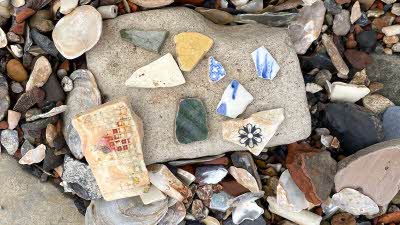
From a pair of plastic boxes, Marilyn takes out examples of artefacts found on this stretch of river, ranging from Tudor stoneware and blue and white Delftware of Dutch religious migrants to the wide rim of a Victorian chamber pot.
“What’s Britain’s favourite drink?” asks Marilyn. “Gin,” someone replies, but the answer lies in a fragment of a teacup, thin porcelain painted in a Chinese style.
Marilyn warns us that we’ll soon be fed up with finding pieces of cream pottery, before describing the multiple oyster shells, not native to the Thames, as the “crisp packets of the day”.
The way pottery has been fired and glazed gives away its age and identity, with pieces that resemble a biscuit with a dark filling evidence of poor firing. Glaze was expensive, so initially only the inside of vessels was glazed for waterproofing purposes.
The Romans settled on the river’s marshy sides in 47AD, although at the time the banks were further back, explains Marilyn, so we’re unlikely to find Roman remains on today’s foreshore.
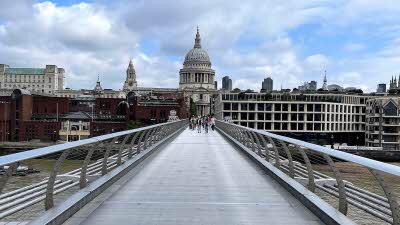

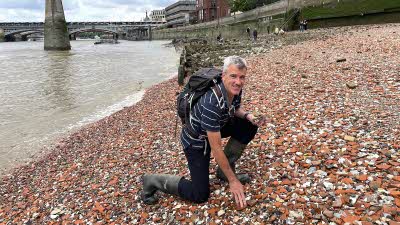



We’ve gathered underneath the shiny Millennium Bridge on land that was formerly the London of the Saxons and Tudors – Westminster to the west was a separate royal city. Steep steps lead from the embankment to the foreshore, where snatches of commentary from tourist boats carry their own tales of the capital’s past.
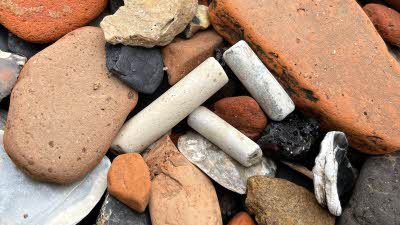
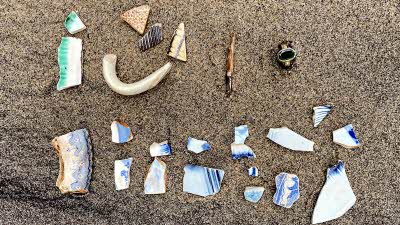
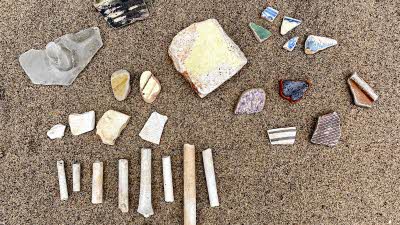
My excitement rises as I spot a section of clay pipe stem, followed by another and another, 17th-century equivalents of disposable vapes. Gradually, my focus sharpens to spot artefacts lying between pebbles – half the handle of a beer flagon, shards of blue and white porcelain, and larger chunks of pottery. There’s such an abundance that it’s not long before I’m discarding smaller finds in favour of bigger pieces, and I quickly abandon bones, unsure whether they are from a Tudor sheep carcass or a spare rib from last night’s takeaway.
The one item I would love to find is a printing block from the famous ‘Doves’ typeface. Way back in 1916, a printer called TJ Cobden-Sanderson decided that he did not want the rights to his font to pass to his business partner. So, over a period of about 18 months he made 170 trips to the Thames to jettison the metal pieces of his typeface into the murky waters below. Almost a century later, a project began to find the lost type and specialist divers eventually recovered 150 pieces.
I don’t find any pieces of type, but I do spot a piece of ramekin with writing on the side. At first glance I think it reads “High Class… chicken”, but closer examination reveals ‘Chich’, leading Marilyn to identify it as a Victorian pot, probably from Chichester.
As we reach the end of the tour, we each deposit our finds in neat patterns by the tidal walls. It’s fascinating to see how the members of the group have connected with different elements of the past. Some have extensive collections of smoking pipes, others have concentrated solely on brightly painted fragments, and others, like me, have a centuries-spanning assortment of pottery, glass, bone and shell.
The star find is a shard of stoneware featuring a hand-painted rose, which Marilyn dates to the Elizabethan era. It’s rather magical to touch and hold something that has endured so many tides, before the piece is placed back on the foreshore beach for another mudlark to find in the years and centuries to come.


A guided mudlarking tour with the Thames Explorer Trust costs £28.