

Great Savings Guide
Our members can save money at some of the top attractions across the UK by using our Great Savings Guide – from historic sites to thrilling theme parks and much, much more.
Find out more
Jonathan Manning finds that carving is good for the soul as he learns to fashion a wooden spoon from a sycamore log


It’s peculiarly satisfying to make something as basic and timeless – yet at the same time as fundamentally useful – as a spoon. At first glance, spoons seem such unremarkable, rudimentary objects, reached for unthinkingly to stir, eat or cook. In fact few items are so aesthetically pleasing and practical – which makes it hard to comprehend how ‘winning a wooden spoon’ became a symbol of failure. As a quick aside, the origin of the prize that no one wants is said to date back to the University of Cambridge of the 19th century, when a wooden spoon was presented to the student who achieved the lowest score without failing in the mathematics exam.
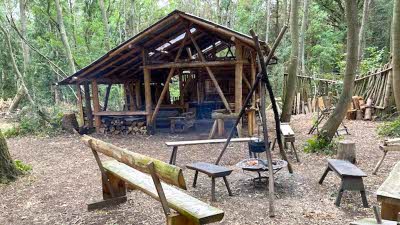
Happily, everyone’s a winner at a class convened in woodland next to Grafham Water Club Campsite. Here, a small group has gathered in a clearing to learn the rudiments of ‘whittling’. It could be a scene from Robin Hood, with an open wooden shelter, wide benches and a blackened kettle simmering over an open fire. To one side there’s a beautiful, gypsy-style caravan, made entirely from wood, and to the other a splendid wooden cubicle housing a compost toilet with a sawdust ‘flush’.
Everything on site has been created by our instructor, Matt, from timber sourced in the 10-acre woodland he bought just a few years ago. It’s a dreamy location, the leafy canopy of oak, ash and sycamore creating a kaleidoscopic effect when the sun breaks through.
There are four students here, including two boys aged nine and 13 whose mothers are keen for them to learn safe knife skills. Despite a comprehensive safety briefing, one person does manage to cut themselves today, and it’s neither of the lads (a line I type with four fingers, my thumb wrapped in plaster and bandage).
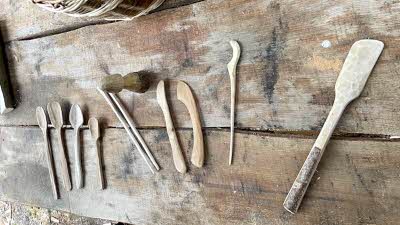
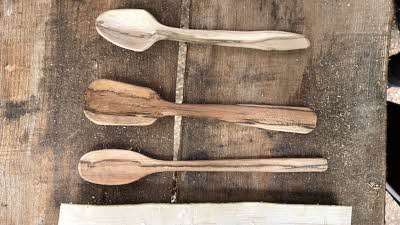
Inspiration for what we might whittle today is lined up across a workbench, and ranges from spatulas to wooden spoons, butter knives, chopsticks and a honey dipper. They’re all beautifully finished and showcase Matt’s years of woodcarving experience – although trying to recreate some of the items may be a tad ambitious in the time we have available. This is a two-and-a-half-hour whittling workshop and Matt’s course dedicated to carving spoons takes six hours.
Undeterred, I decide to make a spoon, initially conceived as a dessert spoon until the challenge of transforming a small sycamore log into an implement that will fit neatly into my mouth necessitates a change in design. A cooking spoon is more useful anyway.

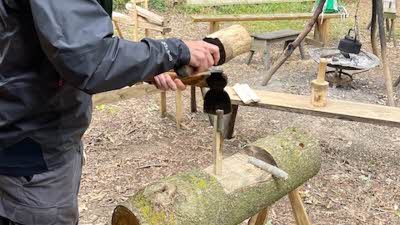
The log is classed as ‘green wood’, its moisture content making it easier to whittle, although my first blows are to be with an axe and mallet. Matt demonstrates, using his handmade mallet and axe − proper green woodworkers make their own tools − before I take over.
Chopping along the grain of the wood turns out to be remarkably straightforward, leaving a rectangular blank upon which I trace the outline of a spoon. Then it’s back to the axe to cut away as much of the wood on either side of the handle as I dare, before the more intricate whittling can begin.
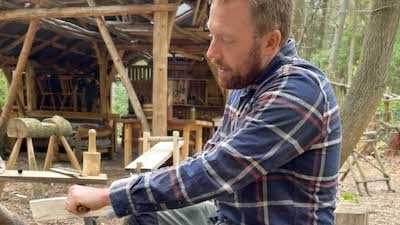
The knife is Swedish, with a thick (2.8mm) carbon steel blade that is bevelled on both sides for a smoother cutting action. “Hold the knife in your right hand, the wood in your left, and lean forward so you are holding the wood beyond your knees,” instructs Matt, putting us in a position where any slip would see the blade slice nothing but fresh air. “You’re aiming for long, thin shavings, not short, thick ones.”
It swiftly becomes a meditative process, each carve of the knife accompanied by an out breath. Given the obvious risk, I’m utterly focused, all thoughts mindfully directed to the task in hand, all anxieties, deadlines and responsibilities relegated to the recesses of my mind.
Archaeologists have dated the earliest woodcarvings to more than 12,000 years ago, and there’s something very calming about sitting in an ancient woodland practising a craft that many generations of ancestors have employed before.
I could easily picture myself doing this on the steps of a caravan or in a camping chair, whiling away lazy afternoons and long, warm evenings as a stick or log gradually takes shape.
It’s a slow process, two hours of work resulting in something more closely resembling a lollipop-shaped plank than a spoon, and it’s surprisingly difficult to achieve symmetrical swooping lines where the bowl meets the handle.
To sculpt the concave bowl, I wedge one end of the wood into my chest and use a hook knife with a blade that curls like one of Aladdin’s slippers. The action is similar to peeling potatoes, albeit with greater peril if you don’t keep your thumb tucked out of the way as you draw the blade towards you. And just to illustrate the danger to the two youngsters, I carelessly leave my first digit in the way of the knife, opening a wound that matches the curved shape of the blade. “Ouch,” I say, glad that the boys can’t mind-read. Matt patches me up with a plaster and bandage before demonstrating again how it should be done. It’s a small, intricate movement, and soon the crater of the bowl starts to form.
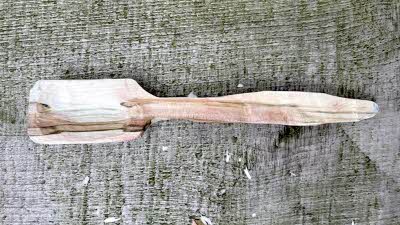
All too quickly time is up, and there’s no question that I’ve created an implement that resembling a piece of kitchen cutlery.
It still needs treating with mineral oil, a process that will both protect it and bring out the beautiful grain in the wood, but it already looks and feels like a winning prize, and not a, err, wooden spoon.
A two-and-a-half-hour Whittling Workshop at Manor Wood costs £32.
Contact: manorwood.uk
Stay: Grafham Water Club Campsite
• Marlborough, Wiltshire
Master the basics of carving sticks into something useful or beautiful, or both, on a variety of one-day courses (£75) with Explore the Great Outdoors.
Info: explorethegreatoutdoors.co.uk, 07920 104466
Stay: Salisbury Hillside Club Campsite
• Bishop Auckland, County Durham
Learn the craft of spoon carving and whittling in the expert hands of the Wiggly Path Company, on a one-day course (£85).
Info: thewigglypathcompany.com
Stay: Durham Grange Club Campsite
• Stirling, Scotland
Carve your own mallet or spatula on a one-day Introduction to Green Woodworking course (£80) with Green Aspirations Scotland, a community interest company.
Info: greenaspirationsscotland.co.uk