Yellowcraig
Nature lovers visiting this site will appreciate the birds and wildlife that are found in abundance amongst the sweeping dunes.
Book this site
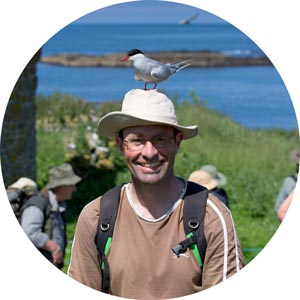
David Chapman spends a summer’s day marvelling at the wildlife of eastern Scotland
 Fidra Island seen from Yellowcraig at sunset
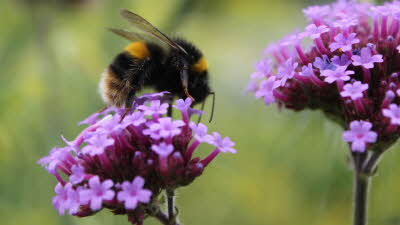
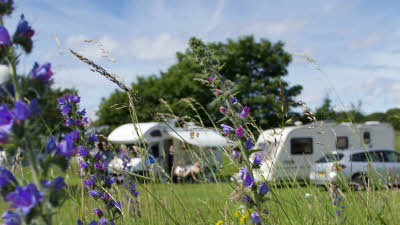
My morning started early with a walk from the ’van, pitched at Yellowcraig Club Campsite near North Berwick in East Lothian. In the heat of the day the verges on site showcased the colours of summer, with poppies, knapweed and yarrow attracting a wealth of insect life. But for now it was still cool as the sun rested on the horizon.
I strolled through the nearby woodland; it was calm enough to hear a leaf flutter to the ground. My heart was lifted by the chirping of both robin and song thrush, while the more strident calls of a jay and a great spotted woodpecker made me all too aware of their presence – and made every other living creature aware of mine!
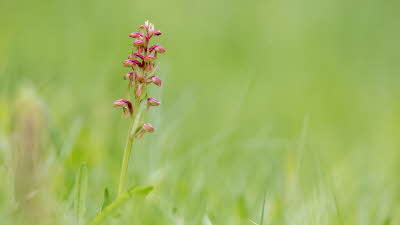
I emerged at a clearing where tall grasses were backlit by the rising sun and an assortment of wildflowers swayed in the soft breeze. Tall spikes of upright hedge parsley and field scabious caught my attention, while, closer to the ground, were the small symmetrical pink flowers of centaury and the yellow frothiness of lady’s bedstraw. After a while I started to identify the stems of orchids, with northern marsh, common spotted and frog orchids all present here.
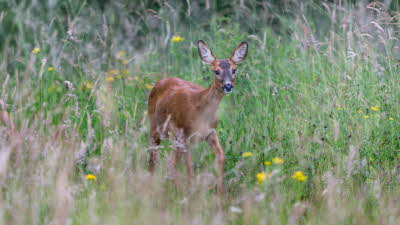
Wandering through the grassland to the open dunes, I watched a roe doe, which had emerged from the same woodland, but without disturbing the jay. She was playing grandma’s footsteps with me: when I turned to walk away, she took a few more steps into the open. She too was looking for wildflowers – I like to identify them and she likes to eat them.
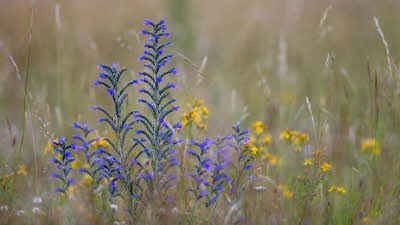
Further out onto the dunes I found more flowers, including viper’s-bugloss, harebells and wild thyme. Later, as the ground warmed in the heat of the sun, I would also find butterflies here, including dark green fritillaries, but for now I had other plans – I was booked on a boat trip from North Berwick to observe puffins on the Isle of May.
There was no need to take the ’van off the site – I decided to walk from Yellowcraig to the tour departure point at the Scottish Seabird Centre. The path led initially through arable fields where I saw more roe deer and a couple of brown hares, though neither was in the mood to let me get close. Yellowhammers sang from the hedgerows and stonechats flitted from post to post.
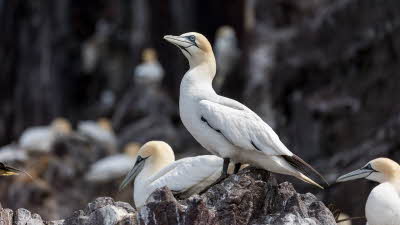
From the bird centre we boarded the boat and were soon bobbing in the Firth of Forth beside Bass Rock, home to the world’s largest colony of gannets, and the reason for this species’ scientific name, Morus bassanus. Grey seals ducked in and out of the nearby caves and we witnessed gannets plunge-diving into the sea to catch their lunch.
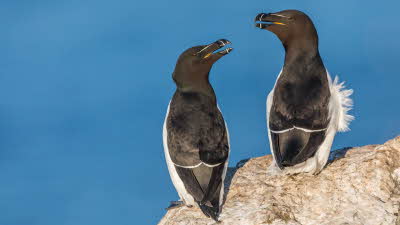
Heading further north, Bass Rock soon became a small dot behind us as a group of rocks, dominated by the Isle of May, began to rise from the sea ahead. Both common and grey seals basked on the rocks and increasing numbers of guillemots, razorbills and puffins began to fly low over the water. One or two terns, probably arctic, flew overhead, with sand eels drooping from either side of their bright red bills.
Soon we were walking the shallow gradient up to the attractive visitor centre on the Isle of May, a Site of Special Scientific Interest owned by NatureScot. After a briefing we were left to wander the island’s network of paths. I could easily have spent a day here, but with just three hours I felt a sense of urgency and made a beeline for the island’s seabird hotspots.
I headed first for Bishop’s Cove. Along the way I watched eider ducks waddling along the path, while puffins mooched around on the rocky ridges to either side. Bishop’s Cove was quiet. There were some razorbills and guillemots, but nothing as close as I might have hoped. Seabird activity often comes in waves – as soon as one puffin shows up others are often close behind. I decided to continue my walk.
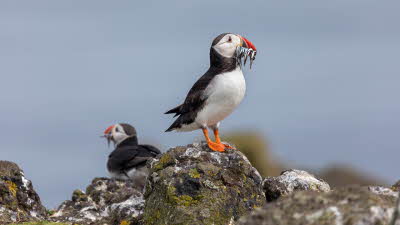
Holyman’s Road, between the low lighthouse and the visitor centre, is beautiful, and from there I began to see puffins heading in from the sea with beaks full of sand eels. They seemed to be aiming for the tip of the island at South Ness, so that’s where I headed. Upon arrival I was greeted by a pair of puffins – one of an incredible 52,000 pairs that breed on this wonderful island. They stood there for all of half an hour before disappearing to feed their young.
Having photographed what I had come to see, I relaxed for the rest of time on the island. I found a spot near to South Horn and soaked up the atmosphere, enjoying displays put
on by shags, fulmars, gulls, auks and terns. Finally, I ambled back to the boat and, as we sped back across the sea to North Berwick, I reflected on a day of contrasts that for me offered the best of a British summer.

I will show you a photo of something from the natural world in every issue of the Club magazine. It might be a close-up, or a subject that is difficult to identify. All you have to do is figure out what it is! Here is the latest photo; no clues or prizes – it’s just for fun.
I will give you the answer in the next edition, but if you can’t wait, log in to the Digital Magazine. The subject of May’s mystery photo was: an emerald damselfly.