There are many reasons why autumn is a special season. David Chapman offers some fantastic photography and wildlife-watching tips

When asked to think of one thing that characterises autumn, most point to the leaves on the trees changing from green to vibrant hues of red, orange and yellow. But that colourful transformation doesn’t typically occur until late October; there are, in fact, many more subtle – and earlier – signs that the seasons are shifting.
We begin to see a change in the natural world as early as August. Many of the birds that visit us for the summer have already started heading south, and those that bred in the High Arctic will be visiting the UK for its milder winter or passing through. Some flowers with a seasonal association – such as autumn lady’s tresses and autumn squill – peak before the end of August and we can clearly see a shortening of the evenings as we enter September.
It’s the ‘shorter’ days during September that spark off some of the most beautiful seasonal changes. Although the days can still be warm, the ‘longer’ nights give the atmosphere more time to cool down – on calm evenings this cold air sinks to the ground where it can cause valleys to be cloaked in mist and grasses to be soaked in dew.
These atmospheric changes transform our world and the photographer in me revels in such conditions – with shorter days we have a more realistic chance of getting up early enough to enjoy the dawn when mist and dew are at their beautiful best. If, like me, you enjoy a creative challenge, maybe it’s time to dust off your camera, go outside and test your skills? Or maybe you would rather watch your wildlife through binoculars? Either way, I have some tips to share and ideas to inspire you to get out and about this autumn.
Caught on camera
Gallery
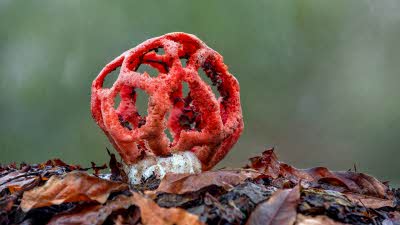
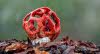
Spotting a red cage fungus can make an autumnal walk memorable
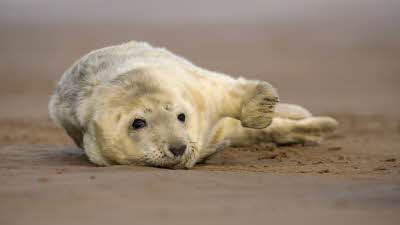
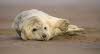
Grey seal pups are born during autumn
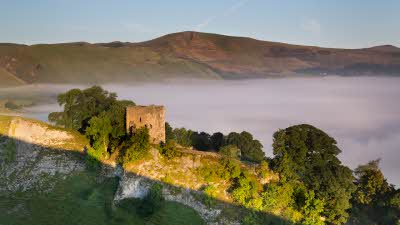
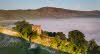
Mist at Cave Dale near Castleton Club Campsite
If you’re hoping to take some great autumnal photographs, consider the following...
- Mist and dew look great when backlit by the sun, but shooting into the sun can cause flare on the lens. Lens hoods are designed to reduce this but, if you don’t have one, try shading the lens from direct sunlight with a spare hand.
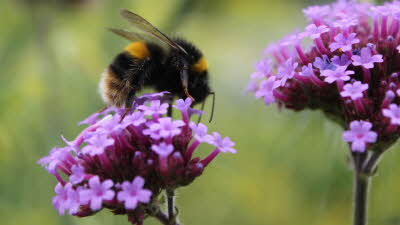
- If you photograph into the light, your subject (maybe a flower, dragonfly or butterfly) can look dark, so try using a reflector to cast light back onto its shady side. I use an old Christmas tablecloth which is gold on one side – you could try silver foil or a piece of white card.
- For misty shots, do some research with a map. For example, identify footpaths that look down from a high vantage point over a valley and try to get there reasonably early in the morning.
- Watch the weather forecast – mist and dew form on cold, clear, calm nights.
- If you are taking ‘macro’ or extreme close-ups (of very small objects or organisms such as insects, flowers or water droplets, for example), use a tripod. It might be fiddly but it will result in sharper images.
- With macro subjects it’s all about the background. Shoot into the light and find backgrounds that have high spots of light which can add something special to the image. Experiment with different apertures if you can, to change the appearance of this ‘bokeh’ (pronounced ‘boker’, this is a word photographers use to describe the ethereal background effect).
- Dew-soaked spiders’ webs can resemble necklaces bejewelled in sparkling diamonds, but look for other, less-obvious subjects such as the seedheads of thistles, feathers and flowers, which can all be transformed by water droplets sparkling in the sun or refracting more distant subjects.
Watching brief
Gallery
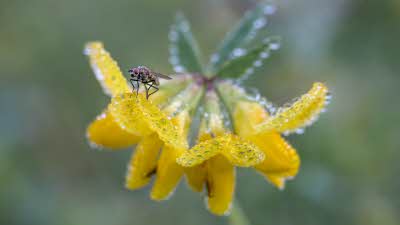
A flower of bird’s-foot trefoil is enhanced by dew
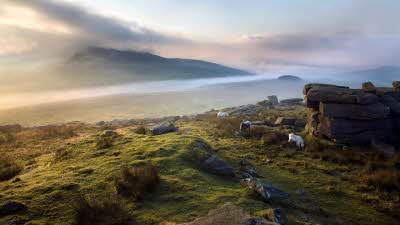
Autumnal mist between Roughtor and Brown Willy in Cornwall
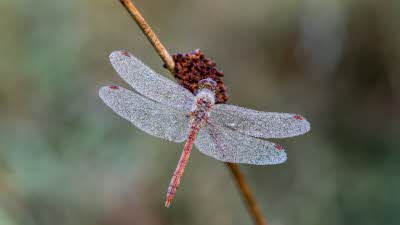
A common darter in an autumnal dew
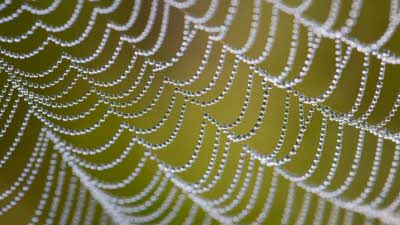
A spider’s web hangs under the weight of a necklace of dew drops
If you simply enjoy watching wildlife, there is plenty to observe during autumn. Here are just a few highlights...
- Red and fallow deer rut in late September through October. Visit a deer park, such as the one at the Chatsworth Estate in Derbyshire (home of Chatsworth Park Club Campsite), to see and hear them.
- Swallows head south during autumn – look for overhead wires where they flock together (safety in numbers) in preparation for their migration.
- Head to the coast in September and October to see migrant birds, including some lesser-seen species. Islands, such as the Isles of Scilly or Shetland, are the best places for observation, but headlands such as Spurn Point and Flamborough Head (Yorkshire), Portland Bill (Dorset), Dungeness (Kent) and Land’s End (Cornwall) can also be great spotting locations.
- Early autumn is a great time to spot dragonflies – including the migrant hawker, common hawker and common darter – as well as willow emerald damselflies.
- Take a woodland walk to look for colourful fungi. Red toadstools, such as the beechwood sickener and fly agaric, are poisonous, so don’t touch! Another species to be left well alone is the red cage fungus – although it looks incredible, it has the odour of rotting meat, which attracts flies and other insects.
- Grey seals give birth to their pups in autumn, and they can be seen around the rocky coasts of Wales, England and Scotland. Good places for spotting in late autumn are the east coast locations of Donna Nook (Lincolnshire), Blakeney Point and Horsey Beach (both Norfolk). To avoid disappointment, check the exact seal-pupping season for each area before visiting.
- Although many birds leave us during the autumn, plenty more are just arriving – look out for redwings and fieldfares for example.
Mystery photo

Every issue I will show you a photo of something from the natural world. It might be a close-up, or a subject that is difficult to identify. All you have to do is figure out what it is! Here is the latest photo; no clues or prizes – it’s just for fun.
I will give you the answer next month, but if you can’t wait, see the Digital Magazine. The subject of August/September’s mystery photo was: fulmar.