
Walking Wanderers
Step away from the everyday and log your miles each month for a chance to win fantastic rewards! Let’s get out there, embrace the fresh air, and walk towards better wellbeing together.
Get walking
David Chapman shares some of his favourite places to look for wildlife during summer
.jpg) The Lizard Peninsula
The Lizard Peninsula
There is wildlife wherever you look, whether you are in a busy city centre or on an isolated mountain top. However, it is extraordinarily revitalising to head somewhere specifically because it is rich in wildlife, or to seek out a particular species.
With that in mind, here are my suggestions for places to visit this summer, including the sites of a couple of well-known seabird colonies, a rewilding area and a pair of nature reserves. Whether your passion is for flowers, butterflies or birds, there is something for you here.
Info: nationaltrust.org.uk, cornwallwildlifetrust.org.uk
Geologically, the Lizard Peninsula is very different from the rest of Cornwall. A lot of the rock is serpentine, which is associated with poor soil – not very good for farming, but great for wildflowers. The Lizard National Nature Reserve is very large, consisting of patches of land all over the peninsula. The most popular is Kynance Cove, owned by the National Trust, which has a car park, café and beach.
The cliffs around here are good for flowers, including nationally rare species such as wild asparagus, spring sandwort and thyme broomrape. A decent variety of other flowers add to the vibrancy of the stunning coastal scenery – look out for thrift, kidney vetch, bloody cranesbill and dyer’s greenweed in early summer, and a variety of heathers (including the endemic Cornish heath) later in the summer.
Kynance Cove is also a good place to spot choughs. Having been extinct in England, these red-billed crows returned to Cornwall to breed in 2001. They chose Lizard Point and have been seen regularly in this area ever since.
Within walking distance, or a short drive, from Kynance Cove is the lovely nature reserve of Windmill Farm, which is managed by Cornwall Wildlife Trust. Through the creation of numerous ponds this has become a mecca for dragonflies with some rarer species such as the red-veined darter often seen. It also plays host to a great variety of butterflies including grayling, and various other interesting invertebrates such as the wasp spider.
Windmill Farm is free to access but it is very informal and the walking can be difficult due to the clumps of coarse vegetation. Also be aware of adders and the possibility of ticks. There is a small car park down a narrow track. For more information visit cornwallwildlifetrust.org.uk/nature-reserves/windmill-farm.
• Club Campsites to consider: Carnon Downs, Godrevy Park, Merrose St Mawes, Trevedra Farm AS.
.jpg)
.jpg)
.jpg)
.jpg)
.jpg)
.jpg)
.jpg)
.jpg)
.jpg)
Info: nationaltrust.org.uk
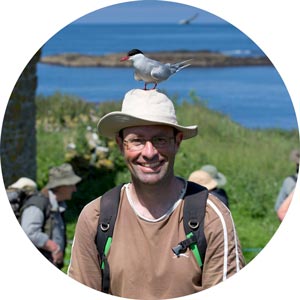
Off the Northumberland coast, the Farne Islands are managed by the National Trust and accessible only by boat, with landings limited to just two hours. Two of the islands – Staple Island and Inner Farne – are of particular interest to bird enthusiasts. The arctic tern colony on Inner Farne is astonishing. They nest adjacent to the path and subsequently dive-bomb anyone passing by, so you need to wear a hat or carry something over your head to avoid being struck by their sharp, blood-red bills.
Puffins can be seen on both islands, although I have always found it better to photograph them on Staple Island, due to the places where they choose to hang out.
Around the islands there are viewpoints from which shags, guillemots, razorbills and kittiwakes can all be seen and photographed. Eider duck nests can also be found, but they are well camouflaged so sometimes difficult to spot. A variety of boat trips is available, including ones that allow landings on both islands in one day; these must be booked separately and in advance. There is a charge for the boat and a charge to land (landing free for National Trust members).
• Club Campsites to consider: Berwick Seaview, Old Hartley, River Breamish
.jpg)
.jpg)
.jpg)
.jpg)
.jpg)
Info: cumbriawildlifetrust.org.uk
Situated on limestone grassland around two disused railway lines and one element of the larger Smardale Nature Reserve, this tiny wildlife enclave has a steep embankment, making access quite limited. I visited the reserve in June and enjoyed it immensely.
I spotted brown hare, redstart, treecreeper, lapwing, curlew and garden warbler, which would have been quite enough to make my day, but the main attraction was the floral displays. I have never seen as many different types of orchid in one place.
Orchids are inherently beautiful, featuring tall spikes of variously coloured flowers. Some have evolved into the most incredible forms to mimic bees, wasps, flies and spiders. Lesser butterfly orchids, for example, were easy to spot. They have creamy-white flowers with long, slender petals. Fly orchids might not sound as appealing, but they have a rich, deep red colour with a bluish patch. Their two thread-like sepals resemble a fly’s antennae and two dark spots look like eyes.
Northern marsh orchids have dense flower spikes of deep pink petals; by contrast, the fragrant orchids (both the marsh and common forms occur) boast a loose flower spike of pale pink flowers. Common spotted orchids can be quite tall, their petals sometimes white but with dark pink patterns. It’s their spotted leaves that give them their name, but beware that other orchids also have spotted leaves.
Other orchids occurring here include common twayblade, marsh helleborine, bee, early marsh and many hybrids. Try to visit from late May to late June to see the greatest variety.
• Club Campsites to consider: Coniston Park Coppice, Kendal, Park Cliffe Windermere
.jpg)
.jpg)
.jpg)
.jpg)
.jpg)
.jpg)
Info: nature.scot
You don’t get any farther north in the UK than this: Hermaness is the most northerly point of the most northerly of the Shetland Islands. Access is by overnight ferry from Aberdeen, then two further inter-island ferry crossings to the island of Unst.
It is an atmospheric location that is home to a huge variety of seabirds. The circular walk, which comprises boardwalk, grassy slopes and some peat bog, is about five miles long and its remote location means you must be prepared for all weathers.
On the moorland there are breeding waders such as golden plover, snipe and dunlin. Red-throated divers might fly overhead, be spotted on lochans or sheltered sea lochs, but for me the main attraction is the chance to watch great skuas, known locally as ‘bonxies’. These large brown seabirds are kleptoparasites, meaning they chase other birds to steal their food. They also attack people who get too close, though they rarely make contact!
A vast seabird colony inhabits the cliffs, among them tens of thousands of gannets, plenty of fulmars, kittiwakes, razorbills and guillemots and, loafing around the top of the cliffs, puffins. One of the best places to see puffins is on the headland called Saito, but be prepared to wait for them to make an appearance.
Wildflowers around the reserve include heath spotted and northern marsh orchids, spring squill, crowberry, bog bilberry, roseroot, thrift, bog asphodel, butterwort, sundew, cotton grass, bogbean and heather.
Visit from mid-May to mid-July for the best seabird experience. Motorhomes with on-board toilet facilities can stay overnight in the car park.
• Club Campsites to consider: Stonehaven Queen Elizabeth Park, Silverbank
.jpg)
.jpg)
.jpg)
.jpg)
.jpg)
.jpg)
Info: knepp.co.uk
Knepp is a re-wilded estate which has become quite well known through the publication of a book and film (both called Wilding) and the introduction of white storks.
Instead of keeping modern breeds of domesticated livestock, fencing them in and managing the land intensively, there has been a shift to older breeds of pigs and cattle which are allowed to roam over a huge area. The animals take charge!
This change in practice has created a wonderful mosaic of habitat types from grassland to meadow, bramble patch to heath, and copse to woodland, all set within a framework of old oak trees. There has subsequently been a noticeable increase in wildlife.
One of the stars here is the purple emperor butterfly, which now has its largest UK colony at Knepp and can be seen in July. The stars of my visit were turtle doves and nightingales, two species of bird known for their distinctive voices. Turtle doves have a wonderful purring call while nightingales have an explosive song containing elaborate and sometimes metallic phrases.
There are plenty of other birds to see, but the white storks draw the most attention. Their huge nests, built on posts and in trees, are noticeable from miles away and sometimes the birds can be seen hunting for amphibians, grubs, worms and insects among the rushes.
• Club Campsites to consider: Daleacres, Brighton
.jpg)
.jpg)
.jpg)
.jpg)
.jpg)